Proof of Life: Why the 'Flaws' in Handmade Clothes Are Actually the Whole Point
There's a coffee-stained vintage jacket hanging in my friend Dana's closet that she would never — not for any amount of money — get dry-cleaned back to its original state. The stain happened on her first solo road trip through New Mexico. It's a mark. It's a map. It's hers.
That jacket tells a story that a pristine, shrink-wrapped piece from a fast fashion rack simply cannot. And lately, more and more people are waking up to the idea that the clothes we actually love — the ones we reach for on hard days and good ones alike — are almost never the perfect ones.
They're the ones that show they've lived.
The Problem with Perfect
Mass production is extraordinarily good at one thing: sameness. Walk into any major retail chain from Portland, Oregon to Portland, Maine, and you'll find the same shirt in the same colorway hanging at the same height from the same chrome rack. There's a certain comfort in that uniformity, sure. But uniformity doesn't move you. It doesn't make you feel seen.
When everything is manufactured to a tolerance of millimeters, when algorithms determine which shade of blue will sell best this quarter, and when the same pattern gets cut ten thousand times by the same machine — what you end up with isn't clothing. It's inventory. And you, wearing it, become part of someone else's spreadsheet.
Perfect is efficient. But perfect is also anonymous.
What 'Flawed' Actually Means
Here's the thing about a slightly uneven hem on a hand-stitched skirt, or a natural dye that bloomed a little differently across the fabric's texture: those variations aren't failures of craft. They're signatures of it.
Japanese aesthetics have a concept called wabi-sabi — the beauty found in impermanence and imperfection. A cracked tea bowl repaired with gold lacquer (kintsugi) isn't considered lesser for having broken. It's considered richer. The repair becomes the story. The crack becomes the feature.
American culture is finally starting to catch up to this idea, and it's showing up in how people shop, what they keep, and what they're willing to pay for. When someone commissions a hand-dyed piece and sees the way the indigo moved across the fabric in a way no machine could replicate — they don't ask for a redo. They ask, can you do it again, just like that?
Spoiler: you can't. And that's the point.
Your Brain Already Knows This
Psychologists who study material culture — basically, how humans relate to the objects they own — have found something fascinating: we assign higher emotional value to things that carry visible evidence of process. A handwritten letter over a typed one. A home-cooked meal over takeout. A piece of clothing with a visible mend over one that looks like it just rolled off a conveyor belt.
This isn't nostalgia. It's wiring. We are meaning-making creatures, and we look for proof that something was cared about before we care about it ourselves. An imperfection in a handmade garment is that proof, made visible. It says: a human being touched this. A human being made choices here. A human being was paying attention.
That's a radically different emotional experience than pulling something off a hanger and thinking, yeah, this'll do.
The Maker's Perspective: Leaning Into the Mark
For independent makers and custom apparel creators, this shift in consumer psychology isn't just interesting — it's an invitation. An invitation to stop hiding the handmade process and start celebrating it.
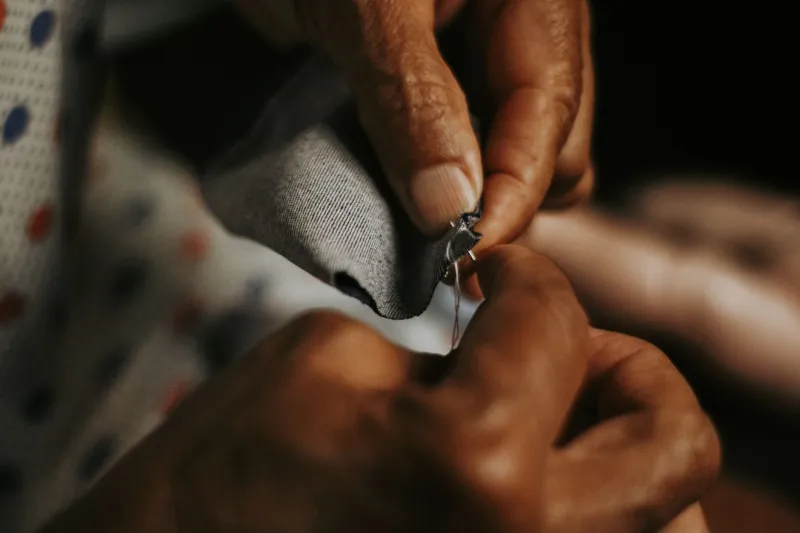
That means showing the variation in a hand-dyed batch, not filtering it out in product photos. It means naming the specific technique behind a visible seam, not apologizing for it. It means telling customers that the slight irregularity in their custom piece is a direct result of the fact that it was made for them specifically — cut, stitched, and finished by someone who was thinking about them while they worked.
At Stained By Me, the name itself is a kind of manifesto. A stain isn't damage. It's documentation. It's the record of something having happened — a meal shared, a moment lived, a decision made. When you wear something that carries those kinds of marks, you're not wearing a product. You're wearing a chapter.
The makers who understand this are already building something powerful: they're not just selling garments. They're selling artifacts.
Reclaiming the Repaired
Visible mending has had a genuine cultural moment in the US over the past few years, and it's not slowing down. Stitchers on social media have turned the act of repairing a torn knee or a fraying collar into an art form — and into a statement. The repair says: this mattered enough to fix. I'm not throwing it away.
That's a radical act in a culture built on disposability.
When a custom piece is made to be repaired — when the maker builds in a philosophy of longevity, when the stitching is done in a way that can be reworked rather than tossed — the garment becomes something you can grow with. The first repair adds a layer. The second adds another. Eventually, you're wearing something that's genuinely yours in a way that no off-the-shelf item ever could be.
The stain that started it all — whatever yours is — is the beginning of that story, not a reason to start over.
Wearing Something That Couldn't Be Anyone Else's
There's a quiet confidence that comes from wearing something made with intention. Not the loud confidence of a logo or a trend, but the settled kind — the kind that comes from knowing the thing on your body was made for you, imperfections included.
When you commission a handmade piece, you're not just getting a garment. You're getting evidence that someone sat down, thought about you, made decisions about you, and built something that couldn't exist without you. The slight variation in the dye? That happened because of how the fabric you chose absorbs color. The way the seam sits? That's because of your measurements, your shape, your life.
No one else has that exact piece. No algorithm generated it. No warehouse holds ten thousand more of them.
You have the only one. And somewhere in it — maybe in the thread color, maybe in the way the hem falls, maybe in a tiny imperfection that only you know to look for — there's proof that it was made by a human, for a human.
That's not a flaw. That's the whole story.