Marked by Hand: The Radical Beauty of Clothing That Carries a Human Trace

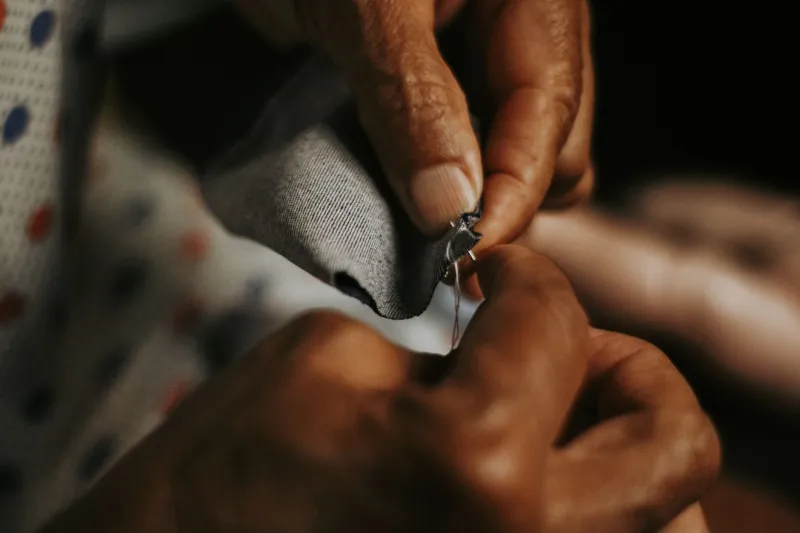
Photo by Photo by Vivek Doshi on Unsplash on Unsplash
There's a small thread tail on the inside hem of my favorite jacket. The maker left it there — not out of carelessness, but because trimming it would have weakened the knot. I've never shown anyone that thread tail. But I think about it almost every time I put the jacket on. It's a little proof. Proof that a person sat down, threaded a needle, and made something specifically for me.
That's the whole idea behind Stained By Me. Not 'stained' in the sense of ruined — but stained in the sense of marked. Touched. Made human.
Why We Learned to Fear the Imperfect
Somewhere between the Industrial Revolution and the Instagram algorithm, we collectively decided that perfection was the baseline. Mass manufacturing trained our eyes to expect zero variation. Every collar identical. Every seam allowance machine-measured to the millimeter. And then social media finished the job — smoothing out every wrinkle, every asymmetry, every visible sign that a human being had anything to do with the final product.
We started applying that standard to ourselves, too. To our bodies, our homes, our choices. The cultural pressure to be seamless — figuratively and literally — became exhausting. And yet, somehow, we kept buying into it. Clicking 'add to cart' on another perfectly photographed shirt that would arrive looking nothing like the photo and fall apart by spring.
The thing is, that kind of perfection was never real. It was a performance. And deep down, most of us know it.
The Stain as Signature
Let's talk about what a 'stain' actually is in the context of handmade clothing. It's not a spill. It's not damage. It's the evidence of process.
It's the slight variation in dye uptake that makes one section of a hand-dyed piece a shade richer than another. It's the tiny pucker at a curved seam where a maker's hands guided fabric around a difficult bend. It's the place where the pattern repeat doesn't align perfectly at the side seam because the fabric was cut by a human being using their judgment, not a laser.
These aren't errors. They're the visual record of a person's hands moving through time and material to create something that didn't exist before. In Japanese craft culture, there's a concept called wabi-sabi — the beauty found in impermanence and imperfection. American culture is just starting to catch up to that idea, and handmade fashion is one of the places where it's showing up most clearly.
When you wear something made by hand, you're wearing someone's decision-making. You're wearing the moment they chose to reinforce a stress point, or decided that a hand-rolled hem would drape better than a machine-folded one. Those choices leave marks. And those marks are the whole point.
The Filter Problem
We are living through a crisis of authenticity. Every image we consume has been processed, filtered, and optimized. Our feeds are full of bodies that have been digitally smoothed, clothes that have been steamed into geometric precision, and lifestyles that have been curated to within an inch of their lives.
And we're tired. Study after study shows that Americans — particularly younger consumers — are experiencing what researchers call 'authenticity fatigue.' The hunger for something real, something unedited, something that actually happened, is enormous right now.
Handmade clothing steps directly into that hunger. You can't filter a hand-stitched seam into looking machine-made. You can't algorithm away the personality in a piece that was drafted specifically for one person's body. The 'imperfections' in artisan-made clothing are exactly what make them impossible to fake — and that's precisely why they're becoming so valuable.
Wearing a Mark vs. Hiding One
There's a difference between a flaw and a feature, and it's almost entirely about intention and context. A stain from a wine spill is accidental. A variation in hand-applied indigo dye is intentional — the natural result of a process that requires human touch to achieve its character.
The philosophy at Stained By Me is built on that distinction. Every piece that leaves a maker's hands carries the mark of that maker. Not despite the craft, but because of it. The goal was never sterile uniformity. The goal was always something that looked like it came from somewhere — and someone.
When you put on a garment that bears visible evidence of its making, something shifts. You carry it differently. You're not just wearing clothes; you're wearing a story that started before you ever put it on. The maker's process, their choices, their time — all of it is threaded into the fabric alongside you.
The Rebellion in the Seam
Choosing handmade clothing in 2025 is a quiet act of resistance. It pushes back against the idea that value is measured in speed and uniformity. It refuses the logic that cheaper and faster is always better. It insists that the person who made your clothes deserves to be acknowledged — not erased.
And it reclaims the idea that you deserve something that shows a little evidence of care. Not a product designed to be indistinguishable from ten thousand other products. Something that has your name on it, metaphorically if not literally. Something that was made with the full knowledge that a specific human being would wear it.
That's what a stain really is, in the end. It's proof of contact. Proof that something real touched something else real, and left a mark.
Wear the mark. It looks good on you.