Wear the Evidence: Why the 'Mistakes' in Handmade Clothing Are Actually the Signature
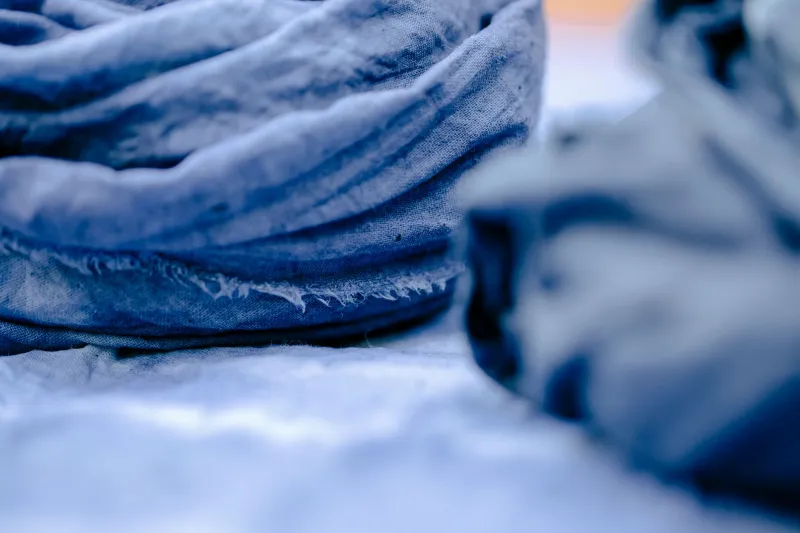
There's a moment that happens to almost everyone who owns a truly handmade garment. You're getting dressed, you catch a glimpse of yourself in the mirror, and your eye lands on that spot — the place where the indigo dye pooled a little too long, or where the hand-stitching drifts just slightly off the straight line. And for a split second, some part of your brain — the part that was raised on Gap ads and perfectly pressed department store racks — whispers: is that supposed to be there?
Yes. It absolutely is.
At Stained By Me, the name isn't accidental. It's a declaration. The stain stays. The mark matters. And the more we understand about how we connect with clothing, the clearer it becomes that those visible traces of making are not defects to be hidden — they're the whole point.
The Sterile Lie of Perfection
Mass production is extraordinarily good at one thing: erasure. Every seam in a fast fashion garment is designed to look like no human touched it. Dye lots are controlled to fractions of a percentage point. Stitches are executed by machines calibrated to tolerances a human hand could never match. The result is a garment that looks, in the most literal sense, like it came from nowhere — untouched, unmediated, without origin.
That sterility is intentional. It's efficient. And for decades, it was aspirational. "Perfection" was the benchmark.
But something has shifted. Consumers — particularly those who've grown up watching the entire cycle of trend, production, and disposal play out at warp speed — are starting to read that uniformity differently. Not as quality, but as anonymity. Not as precision, but as absence. A perfectly identical garment, produced in a run of ten thousand, carries no story because there is no story. It was assembled, not made.
What Your Brain Does With a Human Mark
The psychology here is genuinely fascinating. Research in material culture and consumer psychology consistently shows that people assign higher value to objects they believe have been touched, shaped, or altered by a specific human being. This phenomenon — sometimes called the "Midas effect" in behavioral economics — means that evidence of human contact doesn't diminish an object's worth. It amplifies it.
Handmade clothing activates this in a powerful way. When you see the slight irregularity in a hand-dyed piece — the way the color deepens unexpectedly at one edge, or the texture shifts where a maker's thumb pressed fabric against a resist — your brain isn't registering an error. It's registering a presence. Someone was here. Someone made this. And now it's yours.
That's not a small thing. In a consumer landscape where most of what we own is essentially interchangeable, a garment that bears the literal mark of its maker is a kind of anchor. It has coordinates. It exists in a specific time and place and relationship.
The Japanese Have a Word for This
The concept of wabi-sabi — the Japanese aesthetic philosophy that finds beauty in impermanence, imperfection, and incompleteness — gets cited a lot in craft conversations, sometimes to the point of cliché. But it keeps coming up because it keeps being true.
The cracked glaze on a hand-thrown ceramic mug. The irregular weave in a handloomed textile. The uneven hem on a piece that was measured and cut by a person, not a laser. These aren't failures to achieve perfection. They're evidence of the process itself — of time, of effort, of the fundamental human inability to be a machine.
In American culture, we've historically struggled with this. Our manufacturing identity was built on standardization — Ford's assembly line, the interchangeable part, the idea that consistency equaled progress. But that story is getting complicated. The handmade revival isn't nostalgia. It's a corrective. People are choosing pieces that show their origins because they're tired of owning things that seem to have none.
The Dye That Tells the Truth
Hand-dyeing, in particular, is a process that simply cannot lie. When a maker immerses fabric in a natural dye bath — indigo, walnut, madder root — the result is determined by a hundred variables they can influence but never fully control: water temperature, fabric weight, how long the piece steeps, the mineral content of the water that day, even the weather. Two pieces dyed in the same session will never be identical.
That variability is a feature. Each finished piece is, in the most literal sense, a one-of-one. The bloom of color that pools at one shoulder, the gradient that fades more dramatically on the back panel — these are the signature of a specific moment in the making process. You're not just wearing a color. You're wearing a record of how that color came to be.
The same is true of hand-stitching. A machine stitch is regular to the point of invisibility. A hand stitch has rhythm, personality, the slight acceleration and deceleration of a human working in real time. Embroiderers talk about being able to recognize their own hand in their work years later — the particular tension they favor, the way they start and end a line. That's not inconsistency. That's authorship.
Redefining What "Worth More" Means
There's a version of this conversation that stays purely economic — handmade pieces hold their resale value better, they last longer, the cost-per-wear math works out in their favor. All of that is true, and it matters.
But the deeper value isn't financial. It's relational. A handmade piece that carries visible evidence of its creation gives you something to tell. It gives you a story that starts before you ever put it on. The stain, the imperfect seam, the dye variation — these become the details you point to when someone asks about what you're wearing. They become the things you notice, years later, that remind you of when you got it and why.
That's a fundamentally different relationship with clothing than most of us have been trained to expect. We've been taught to want things that look new indefinitely — to hide wear, to iron out irregularity, to keep up appearances of pristine perfection. Handmade clothing invites the opposite orientation: wear it, let it develop, let it accumulate the marks of your life alongside the marks of its making.
The stain stays. And that's exactly why it's worth something.